Also this spring, Nancy contributed one of the first C3 Research Memos distributed to C3 Consortium Members. This C3 Research will be made publicly available via the C3 blog in late November of this year.
While here in Cambridge, Nancy was asked to speak at the Berkman Center at Harvard Law School. Her talk (in the embedded video below) entitled "Changing Relationships, Changing Industries" addresses her thinking on notions of exchange (economic and social) between fans, audiences, the music industry and the independent music scene - specifically in the case of independent Swedish artists and music labels.
Nancy's insights into how the independent music scene by necessity has embraced new media distribution channels and the audience embrace of these new channels, as well as her insights and metrics on the major label music industry as an inadvertent 'loss leader' in the swift dismantling of the top down corporate music hierarchy (which we are now seeing manifest in film and television) were an early influence on what became 2008 - 2009 C3 research on new consumption patterns, new patterns of value exchange, along with innovative ideas surrounding value and worth - specifically the 2008 C3 White Paper on Spreadability, Xiaochang Li's 2009 C3 White Paper More Than Money Can Buy: Locating Value in Spreadable Media, Ana Domb's 2009 White Paper Tacky and Proud: Exploring Technobrega's Value Network and the CMS C3 FOE4 Panel, Moderated by Prof. Jenkins entitled "Consumption, Value and Worth" (panel video here, liveblogging archive here).
Transmedia Entertainment keeps getting more and more buzz these days -- and so over the next handful of installments, I am going to be sharing with you a range of different perspectives on the concept.
Today, I am running the first of two installments showcasing the work of Marguerite de Bourgoing, one of the USC students who took my transmedia entertainment class last fall. de Bourgoing has been developing a grassroots media franchise, LAstereo.tv, which deploys YouTube and social network sites to showcase the Los Angeles hip hop scene. de Bourgoing represents the Trojan spirit at its best -- a social and cultural entrepreneur who is taking what she's learned as a media maker and deploying it to serve her larger community. de Bourgoing shared some of this work with us during the class and I've wanted her to talk about it for my blog since. In this account which follows, she both shares some of the videos she's been producing and also talks about the way LA Hip Hop artists are using new media to expand the community around their live performances. It's a perspective on transmedia we don't hear very often here and further helps us think about the impact of media convergence on our culture.
The Transmedia Potential of Music Videos, Part 1: The Band
With the uneven future of the music industry and its models, I've become really interested in exploring the potential that music has by integrating these old tactics into transmedia storytelling and cross-platform distribution frameworks.
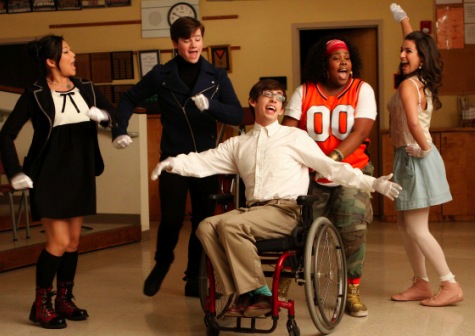
Previously, I've gushed about how the hit television show Glee has experimented with these methods with respectable success. The Glee model takes advantage of the ease of cross-platform distribution as a business model; however, it's a bit difficult to discuss the transmedia storytelling elements of its story. In my Glee article, I attempted to speak to the idea of affective economics, "which seeks to understand the emotional underpinnings of consumer decision-making as a driving force behind viewing and purchasing decisions" (Henry Jenkins, in Convergence Culture). Glee's story extends beyond its original narrative when expressed by its consumers and especially its fans, by understanding characters better through playing their songs, or by performing favorite dance routines.
Unfortunately, what I can't argue is that the producers of Glee have themselves extended the story across mediums. In response to this basic fact, I've been trying to look for the appearance of other types of stories that span multiple forms of media. Today, I want to discuss the band OK Go and how the story of not the songs but the band has succeeded in with a transmedia model.
And now the story continues... On Wednesday, OK Go announced that they will be leaving EMI to set up their own independent label.
C3 White Paper: Tacky and Proud, Exploring Tecnobrega's Value Network
The third installment of our 2009 C3 white paper releases. This white paper was penned by Ana Domb Krauskopf.
Tacky and Proud: Exploring Tecnobrega's Value Network
This paper explores the role of audiences as productive actors in the music industry and uses the value network as an analytical tool to facilitate the process of locating audience involvement and specifying the audience's role as creators of economic and symbolic value. Our main case study in this white paper is Tecnobrega ("Cheesy Techno"), a grassroots Brazilian music industry found in Belem (the capital city of Para, a northern state of Brazil). Tecnobrega evolved outside mainstream media, yet it became a successful music scene thanks to its innovative forms of production, distribution, promotion, and its strong relationship with audiences. Tecnobrega has also benefited from increasing widespread internet access throughout Brazil.
It's that time of year. Festive lights cover windows and lawns. People buy trees to put in their living rooms and unpack fake versions from boxes in their basements. Holiday specials are on TV. Lists are made for Santa. Family visits and travel plans start to take shape.
Popular culture often provides a secular interpretation of the meaning and celebration of Christmas, emphasizing its significance as a time of peace, goodwill, friends and consumption. Whether in the form of movies or malls, these interpretations have made Christmas more accessible to people by not requiring a connection to Christianity.
In that spirit, I've compiled my top 10 list of representations of Christmas in popular culture. Read on, then leave a comment and tell us what's on your pop culture Christmas Top 10.
Singing in the Living Room: Fueling the Business Model of FOX's Glee
Warning: This article on Glee might tend toward the meta, as while I write this article, I will be listening to the first Glee Soundtrack*: seventeen songs from Ryan Murphy's hit show on FOX. And the songs are exactly what I wish to discuss: the transmedia of music.
* The second soundtrack was actually released for sale two days ago on December 8th. If you want to listen to and/or purchase the first soundtrack, you can find it on iTunes or Amazon.
During the Futures of Entertainment 4 conference, as Henry Jenkins comments on his blog, "Nancy Baym asked us to think about when and how music has gone transmedia. We struggled to come up with examples - everyone of course immediately latched onto the ARG created around the Nine Inch Nails; I proposed the comic book Tattoo where artists and writers used Tori Amos songs as their inspiration." What I wish to bring into the limelight is that we've been participating in a musical transmedia experience of epic proportions for the past few months, on TV, on Hulu, on our iPods, and even in our living rooms: the rockin' music of Glee.
Before I continue to discuss how exactly Glee works as transmedia, let me discuss the concept of the fan experience. Henry also writes in the same paragraph, "The question looks different, though, if we ask about transmedia performance, because most contemporary musical artists perform across multiple media - minimally live and recorded performance, but also video and social network sites and Twitter..." Back in October, I wrote an article for the Consortium blog, Performing with Glee, which examines the fan (re-)production that has emerged on YouTube from reenacting scenes from Glee's television episodes. While this fan performance has pushed the Glee experience into a transmedial mode -- the total experience of interacting with the Glee "franchise" spreads across mediums, regardless of its production origins -- the fan activity obviously is not the same as the actual artists or content producers performing across mediums. I try to make the distinction obvious, especially by putting quotation marks around franchise, above, because when we consider transmedia, usually we apply the term franchise to the complete production consumed by the audience without taking into account the extensive continual experience that moves beyond the original production (think: Star Trek conventions, anime cosplayers, or even Superbowl celebration parades).
So I wish, in examining why Glee's business model has been so successful, to explain how Glee's business model has been so successful. And this is due to the fan experience.
Fans reject the idea of a definitive version produced, authorized, and regulated by some media conglomerate. Instead, fans envision a world where all of us can participate in the creation and circulation of central cultural myths... Media conglomerates often respond to these new forms of participatory culture by seeking to shut them down or reigning in their free play with cultural material. If the media industries understand the new cultural and technological environment as demanding greater audience participation within what one media analyst calls the "experience economy," they seek to tightly structure the terms by which we may interact with their intellectual property, preferring the pre-programmed activities offered by computer games or commercial Web sites, to the free-form participation represented by fan culture. The conflict between these two paradigms -- the corporate-based concept of media convergence and the grassroots-based concept of participatory culture -- will determine the long-term cultural consequences of our current moment of media in transition.
Henry wrote up a revised version of this essay (which appears on his website, linked above) in his Convergence Culture book, which is obviously an important read if you've never picked it up before.
But coming away from this excerpt above, I can't help but feel that the first sentence suggests a very intense feeling, given what I assume to be a more subdued general viewership that constitutes a given show's (or movie's, or band's, etc.'s) fan base. Given that the modes of "participatory culture" are pervading the contemporary media landscape almost everywhere today, I still hesitate to state outright that fans "reject the idea of a definitive version" of any kind of narrative or media. Fans certainly work inside the construct provided by the "media conglomerate" and participate by interacting with the established narrative or media form.
What these initial thoughts are really leading up to is my attempt to spout a bit about Glee.
I originally had another topic planned for this article, but I decided haphazardly to change it at the last minute, because one video made such an impression on me yesterday morning.
My morning routine consists of a few primary objectives, one of which is to browse my Twitter stream to find anything of note or something missed during the night. I noticed that Henry had posted a link to a YouTube video late Wednesday night under the guise of:
Susan Boyle's Legacy?: Winning performance from Ukraine's Got Talent has Drawn more than 2 Million views. http://bit.ly/zDFFT
The link sent me to the video embedded below. While the clip lasts 8 minutes and 33 seconds, I highly recommend taking the time to watch through the entire video. This is storytelling at its finest.
The astounding ability of a hand to shape a story is purely evidenced by Kseniya's work. It's simply awe-inspiring at how simple movements of addition and subtraction, how curves and lines and cuts can craft such simple yet refined art. I find it more beautiful because the scenes flow and crash (literally) into each other. Metaphors become real images. After the planes enter the scene, at 1:47 Simonova scrambles the bench-sitting couple into a blur of sand, a blur that represents fear, but a physical swirl that becomes the scared face of the female onlooker. When the bombs hit at 3:08, Simonova throws a handful of dust onto the baby, eliminating him symbolically and literally from the picture.
This video represents a piece of wondrous art and fanciful storytelling. And by the posting of this article, it has probably reached over 3 million views on YouTube. After the jump, I'll examine some more implications that this video presents about YouTube, transmedia, and cross-platform distribution; how we explain our understanding of popularity online; and how the Internet complicates our comprehension of foreign cultures.
Report From the Land of Açai Berries and "Cheesy Techno"
A couple of months ago I mentioned that I was heading to Belém, home of Tecnobrega (yes, it means cheesy techno) and the apparently miraculous açai berry. I spent around ten days doing participant observation and interviews with various members of the Tecnobrega community, mainly their enthusiastic and generous fans. Although I'm still working on the research, I figured I could share a few of my observations right away.
Tecnobrega has become well known because of its copyleft approach to music production/distribution. In theory, musicians "give" their songs to the "pirates" (who make and sell the CDs) and to the DJs (who promote them at the party). The musicians make money off live concerts. Because the musicians choose to not copyright their songs, all remixing and reselling is completely legal, but tecnobrega does use music from other places as well (I was subjected to Britney Spears more than once). Songs are "used up" every month or two, so they are in constant need for new music, but, for a while now, the DJs have become the center of the tecnobrega scene, concerts are less common and musicians no longer have a secure income even if their songs are popular. Having said that, Tecnobrega's business model has a particularly dynamic quality to it, and hopefully they'll come up with yet another solution that fits their new reality.
Remember when a few days ago I was telling you about all that research we were going to be conducting in Brazil? Well, I didn't tell you the whole truth. My colleague Xiaochang Li and I accepted an invitation from IG, one of our two Brazilian partners, to come to Carnaval in Salvador da Bahía. It has been an invigorating experience.
Bahía is located in the Northeast of Brazil, and besides being known for its natural beauty it is also one of the most artistically prolific states in the country, and that's saying a lot. Salvador gave birth to Joao Gilberto, Dorival Caymi and Vinicious de Moraes, fathers of Bossa Nova, but also to the more disruptive tropicalismo movement; this is the hometown of Caetano Veloso, Gilberto Gil, María Bethania, Gal Costa and many more. This brief paragraph doesn't begin to describe the richness of this town's musical heritage, for now, I can say that I'm in awe.
The last city to touch the Amazon river is also the home of Tecnobrega, a passionate musical movement rooted in the traditional Paraense rhythm, brega, which literally means cheesy or corny. This music, or more specifically, the fan communities around it, are the focus of my research this term at C3.
Tecnobrega is what Ronaldo Lemos, Project Lead of the Creative Commons Brazil, calls a "globoperipheral music". He sustains that within this type of musical environment the "idea of a "periphery" is not related to a geographical concept, nor does it have to do with a division between rich and poor, it has evolved and in its evolvement it has become both North and South."
Last year David Byrne wrote a wonderful article in Wired explaining different music distribution strategies for emerging artists, in the first few paragraphs he explained: "What is called the music business today, however, is not the business of producing music. At some point it became the business of selling CDs in plastic cases, and that business will soon be over. But that's not bad news for music, and it's certainly not bad news for musicians."
The problem though, is that although the concentration of power within the industry has shifted significantly, it hasn't necessarily put the artists or audiences in the driving seat. "Music industry" is no longer synonymous with "recording industry", but that's just because now it's all about live events and ancillary deals and there are two "major" companies dominating that scene: Ticketmaster and Live Nation and soon it might just be one.
FOE3 Liveblog: Session 7 - Global Flows, Global Deals
So we finished out FOE by trying to push some of the key themes of the conference into a global context, with panelists Nancy Baym (Personal Connections in a Digital Age), Robert Ferrari (Vice President of Business Development, Turbine Inc.) and Maurício Mota (Director of Strategy and Business Development, New Content Brazil).
The panel was moderated by C3 Reseacher Xiaochang Li (that would be me, for those of you playing at home) and Liveblogging was done by Harvard undergraduate Christina Xu.
Introduction of Panelists:
Nancy Baym: I study fans on the internet. I come at it from an interpersonal relationship and community building angle. I'm more interested in music fans than the narrative music, and how they relate to other fans in relation to pop culture material. I'm especially focused on Swedish/Scandinavian music flowing out of Swedish borders.
Bob Ferrari: VP of Business development, Turbine Inc. Looking at the online gaming side of the business. Turbine is a studio, 350+, based in Boston with a small office on the West Coast, that focuses on social (MMO) gaming. We build these deep dynamic worlds around brands (LoTR, D&D) and bring in hundreds of thousands of players into these live worlds and allow them to play & socialize. What I've been doing is driving it not just domestically, but also bringing them to other countries (Russia, starting South America, China/Hong Kong, Korea).
Mauricio Mota: Director of Strategy and Business Development, New Content. Pioneer company on branded content, leading the process of bringing transmedia storytelling to Brazil. Managing all of Unilever's 29 brands.
Videos by Mauricio and Bob (embedded to the C3 blog here
Kpop Goes Global (part 2): SM Global auditions and transnational fan culture
In my previous post on the SM Global auditions, I talked about the complications within the very idea of "global" in the contexts of national markets and the anxieties or tensions surrounding the what is meant by the "global" stage, especially when "globalization" is used not simply as a euphemism for westernization.
In this part, I would like to draw out another, perhaps related, component, which was the function of the SM Global auditions as a transnational fan space. Rather than functioning as straight talent gathering, the auditions in fact worked as a sort of fan-relations event that not only did not require the presence of celebrities, but also worked to direct fan energy from the individual artists towards the larger company brand as a whole, a critical strategy in the development of new artists.
Here's some juicy news concerning last year's "pay what you want" experiment from Radiohead: according to Rolling Stone and musically.com, Radiohead's publisher Warner Chappell confirmed yesterday that "Radiohead made more money before In Rainbows was physically released than they made in total on the previous album Hail To the Thief".
Ths site for C3's annual conference, the Futures of Entertainment, now in its third year, is now live.
Registration information will be soon to follow, and be sure to check in for updates to speaker lists as we start to finalize our panels in the upcoming weeks. This year promises to be exciting and provocative, as we push our themes of convergence and media spreadability onto the global stage, while not losing sight of central C3 issues such as transmedia storytelling and audience value.
To get an idea of what the Futures of Entertainment conference is like, check out last year's site and listen or view the podcasts.
Kpop goes global: notes from the SM Global Auditions (part 1)
Since much of C3's research this year, as well as my individual work, seeks to examine how the principles of cultural convergence and media spreadability play out on a global scale, it was with great enthusiasm that I set out to do ethnographic fieldwork at this year's SM Global Auditions in New York (Flushing, Queens, to be exact).
SM Entertainment is one of the biggest and most elite talent stables in Korea and, thanks to growing prominence of "the Korean Wave," across much of Asia. Known for their pop music talent, in particular well-groomed and intensely professional girl groups and boybands with up to over a dozen members per group. Their strategy, like many successful talent agencies throughout Asia, is to recruit extremely young, usually pre-teens and teenagers, and then put their recruits through extensive training and often, not insignificant amounts of plastic surgery, before choosing the most promising ones to "debut," or launch officially, as "idols." Once most of these "trainees" debut, the press accepts them directly as celebrities, and fans are often carried over based on the SM Entertainment name, as opposed to the group's individual talents.
Their Global Auditions, according to SM's website, are an effort to discover talent that can "stand on the stages of Asia and the world." Despite the name, the auditions were only held in the US and Canada, in 8 major cities, like New York, SF, LA, and Toronto, that are known to be centers of the East Asian diaspora. News of the auditions were spread online, via blogs, message boards, and SM's own website. SM also made recruitment videos featuring all their biggest acts, which got uploaded onto Youtube, Veoh, Dailymotion, Crunchyroll, and a number of video-sharing sites. These circulated mostly amongst fans of the groups, acting both as recruitment and promotional footage for SM Entertainment, but it also ensured that a significant portion of the people at the auditions were fans, rather than people seeking to seriously pursue entertainment careers.
As such, the auditions were an interesting site in which certain tensions between concepts of global and national, fan and "professional" surfaced. This first part will discuss the tensions of national origin and "global" media reach, while part 2 will deal with the auditions as simultaneously a site of professional development, but also fan participation.
This is the fourth in a series of "intimate critiques" produced by masters students in my Media Theory and Methods proseminar that I've been running over on my blog. Since Kevin will be speaking as part of a Consortium-organized colloquium event on Thursday regarding his work on video sharing sites, I thought it would be a great idea to share his post with C3 blog readers as well.
Here, Kevin walks us through the process by which he learned to hear and appreciate a mix tape which initially challenged him both formally and ideologically. In the process, as a young white male, he confronts some explicit lyrics which force him to re-examine some of his assumptions about race, class and sexuality. This essay may take some readers out of their comfort zone -- and that's part of its point, since he is trying to explain how we renegotiate our senses of ourselves when we encounter forms of expression which do not fit our norms or pre-established tastes.
Bitch Ass Darius "Follow The Sound" Mixtape
by Kevin Driscoll
The CD itself is rather unassuming. Sleeveless, its face bears a name and phone number handwritten in Sharpie. Flip the disc over and you might suspect it is blank. The area pock-marked with data stretches from the center hole to just before the outermost edge. Drop it into a CD player and you'll discover that there are eighty tracks, few of which extend beyond sixty seconds.
I met Joe Beuckman in the summer of 2003 when we performed together in a small artspace located inside one of dozens of post-industrial hulks scattered around Allentown, PA. He gave a demonstration about reverse engineering Nintendo cartridges, showed off a vinyl record used to store executable computer instructions, and then scratched that record over Three 6 Mafia's "Sippin' on Some Syrup" while shouting, "I'm scratching data right now!" I introduced myself after the show and he gave me CD-Rs containing the latest mixtapes from two of his DJ alter-egos: Kenny Kingston and Bitch Ass Darius. Kenny Kingston is a lover of early-90s dance music: house, hip-hop, r'n'b, and new jack swing. Bitch Ass Darius plays a mixture of Miami bass, acid house, and pitched-up Detroit techno known occasionally as "ghettotech" or "booty bass." While I found familiarity, comfort, and nostalgia in Kingston's pop-heavy mix, everything about Darius' mix, from the super-fast tempo to the puerile lyrics, felt alien and alienating.
Espaço Cubo: Creating New Centers from the Margins
One of my first posts on this blog was on DocTV an Ibero-American documentary coproduction program that was first initiated in Brazil. One of the reasons that I continue to admire that project is that it addresses all the needs in the value chain in a constructive and inclusive manner, working with artists and both the public and private sector. Now, through a class on public art with Antoni Muntadas at MIT in conjunction with the São Paulo University, I was able to finally visit Brazil and discovered a country that is bustling with creativity and drive.
There, the musician and producer Benjamim Taubkin let me know about a grassroots project that shares those same laudable characteristics with DocTV, but, instead of being generated from the country's center, it was brewed by group of young social scientists in Cuiabá in the Mato Grosso province. It's called Espaço Cubo, and it has grown from an experiment into a full-fledged movement.
In the first part of this post I referred mostly to the case of Starbucks' Hear Music. This idea of selling something else through music, sometimes very good music, reminded me of the case of another label, Putumayo. Founded by Dan Storper in 1993, Putumayo World Music's motto is "guaranteed to make you feel good" and their purpose to introduce "people to the music of the world's cultures." In April of 2007, Storper commented to The New York Post that, in those same five years when the music industry had officially entered a period of crisis that caused so much anguish to the majors, his company increased its sales by an average of 10 percent annually.
Music from the Wine Lands (2006) is a prototypical Putumayo album that comprises all of the characteristics described above. It contains a "a full-bodied selection of songs from the world's leading wine-producing regions" aimed at the "music lover and the wine drinker in everyone." The cover is set in a time-ambiguous villa in an idealized bucolic Europe. The album includes music from France, Spain, Chile, Argentina, South Africa, Greece, Portugal, Italy, and the U.S, ranging many different genres. Their common denominator is that they come from countries that produce wine.
A few weeks ago, The New York Times published an article on the Starbucks' music label Hear Music where they contend that the latte mogul is watering down their musical supply. Worse even, the article suggests that, "despite adopting a broader musical approach, Starbucks on average sells only two CDs a store each day at company-owned shops, according to people briefed on its business. Starbucks disputed that figure but declined to provide a different one."
This mainstream approach, successful or not, apparently goes counter to their original focus on undiscovered music. After all, it was Hear Music that put Madelein Peyroux's Careless Love on the map. As an alternative retailer, Starbucks is a dream, but since the label is the coffee shop franchise itself, my sense is that they are not about selling music, but rather about selling some sort of commoditized authenticity, status and most of all, the Starbucks brand. This gives them permission to create a catalogue that appeals to a target as wide as those who are willing to pay $3.50 for a cappuccino, and incredibly enough, that's a large chunk of people. This has meant that Hear Music now offers Simon & Garfunkel and James Brown, a far cry from undiscovered artists.
Last.fm, Online Music Distribution, and Cross-Platform Promotion
The Web has brought discussion of crises to traditional media for a variety of industries. However, no industries have been hit harder than newspapers and music, in terms of rhetoric about Internet culture and consumption signing the death warrant for those industries as we know it.
I have written multiple times in the past about the plight of newspapers here on the C3 blog (look here and here, for instance), while Ana Domb has written multiple times about changes in the music industries (see here and here).
Last month, Ana wrote specifically about how 2007 was considered "the year the media industry broke," writing further that:
My sense is that the music industry is not broken, but it is going through terrible growing pains. It's outgrowing its parents and struggling to find its new identity. (We all know that this is a long and painful process.) Now, granted, "parents" is not the strongest analogy for the music labels, since they have NOT given birth to music, and some might argue they've done just the opposite. For the moment, though, let's consider them the music industry's legal guardians.
We have yet to find out what this new music industry will look like, but changes like the ones that took place last year will help consolidate an important shift in the dominant power structure. Much has been said about how this change has empowered the audience, and certainly Radiohead and Nine Inch Nails respond to this trend, but they also reflect the increasing power that the creators have obtained over the production and distribution of their content. This will be a long, slow and interesting struggle. And I would say that, in spite of the industry's flare for the dramatic, it will be a while until everybody knows what their new role is, what they are allowed to expect, and how they can relate to each other.
This all takes me to Last.fm, a CBS-owned music site which allows users to listen to a wide variety of musical choices, on-demand, for free, with advertising support. The positives? Through CBS's reach and access to a deep reserve of music, users can line up their own mix of music to play for free without interruption. The negative? At current, a track is only allowed to be played three times. Otherwise, users are linked to iTunes, Amazon, and other outlets to buy that song from.
The music industry has a flare for the dramatic. As such, last year has been repeatedly portrayed as the year that the music industry broke and October as the month that sealed the deal. That was when RIAA won its first major file sharing lawsuit, reinforcing their perception of consumers as potential criminals.
More importantly, however, it was the month that Radiohead announced its pay-what-you-want scheme; Nine Inch Nails declared itself 'a totally free agent, free of any recording contact with any label'; and Madonna terminated her 25-year relationship with Warner Music Group and signed a 360 deal with Live Nation.
"Meet me at my crib . . .": Reading the official "Crank That" video
Last week, I brought up the phenomenon surrounding Soulja Boy and the "Crank Dat" dance craze that propelled him to success and touched upon a few of the things that drew my attention to this particular case. This week I thought I'd dig in a little further, and try to tease out some of the things that Soulja Boy really embodies for me (as a concept more than as a musician or performer) through a closer examination of his official music video, which touches upon a lot of these themes of production, participation, and distribution in the age of convergence.
Last week, the mainstream music industry was (yet again) turned upside-down. British rock band Radiohead announced that it had finished its latest album IN RAINBOWS. Their website says:
RADIOHEAD HAVE MADE A RECORD
SO FAR, IT'S ONLY AVAILABLE FROM THIS WEBSITE
YOU CAN PRE-ORDER IN THESE FORMATS:
DISCBOX OR DOWNLOAD
So why is this such big news? Well, the first clue is in the band's low-key notice: "so far, it's only available from this website." In Rainbows is Radiohead's first album since they concluded their contract with EMI, and, so far, they've decided to release it on their own.
Hustling 2.0: Soulja Boy and the Crank Dat Phenomenon
A little while back, Kevin, one of my colleagues here at MIT, brought the Soulja Boy YouTube phenomenon to my attention while we were discussing an upcoming project.
Fast forward to October: Soulja Boy is fending off Britney Spears and Kanye West on the Billboard Top 100, and you can now watch a rag-tag team of MIT grad students, researchers, affiliates, and Richard Stallman, founder of the GNU project and the Free Software Movement, crank that:
(CMS program director Henry Jenkins even joined in the learn the dance, but sadly had to run off to something undoubtedly important before the video was shot.)
Grooveshark and Amie Street: Two Interesting Business Models for Music Distribution
Worldwide physical CD sales are taking yet another dip. Online stores are hardening the competition and being forced to come up with more creative strategies to entice the ever-so-elusive consumer. Meanwhile, certain artists consider profit from recorded music marginal and focus on concerts and other tour-related revenue streams.
It's in this tricky landscape that newcomer digital music stores Grooveshark and Amie Street plan to make their mark. Both companies exploit and reward the fans' loyalties toward their groups and take advantage of the social networking model.
C3 Team: DRM, Hypermasculine Soaps, and Gender and Fan Studies
In addition to all that we've been covering here on the Convergence Culture Consortium blog, there have been some interesting pieces written recently on the blogs of some of our consulting researchers as well that I'd like to point the way toward.
First is a recent post from C3 Consulting Researcher Rob Kozinets, over at Brandthroposophy, his blog on "marketing, media, and technoculture." In a post entitled What Does DRM Really Stand For? Whack-a-Mole!, Kozinets thinks back to a conversation with an executive from the music industry in a class he taught back in 1999, talking about early MP3 players, and his own conversations with students over the years about file sharing and digital rights management, for both music and movies. He concludes that "entertainment companies haven't even come close to getting it. When they do, they'll learn to work with the trends and not against them. That's going to be an interesting day."
When you are living in Western Kentucky, especially working in the media industry, few days go by without hearing something about bluegrass music, especially since the genre has received such a resurgence in popularity over the past few years, after the Coen Brothers' O Brother, Where Art Thou? introduced the music to mainstream America with its outstanding soundtrack.
My home county is considered "the birthplace of bluegrass music," because the man often considered the genre's father, Bill Monroe, and many other founding voices for the style, were born in the small town of Rosine. At least once a month, public debate has popped up in our small town, as the Bill Monroe Foundation hopes to gain control of the county's budget to help increase the drive for tourism traffic through Monroe's home place. (The wars over bluegrass music are more than can be detailed here, but--so far this year--they've included a public battle and debate over a semi-sacred tree on the homeplace between the county government and the BMF director and a current battle over the trailer which houses the BMF director being located on someone's property who wants it removed.)
However, bluegrass music and our neighboring Muhlenberg County's thumbpicking movement provides a space where most of the historians and scholars studying the music also play the music. In the latest Journal of American Culture, Dan Cusic of Belmont University reviews both Neil Rosenberg's groundbreaking Bluegrass: A History, now celebrating its 20th anniversary, and Bob Black's Come Hither to Go Yonder: Playing Bluegrass with Bill Monroe. He writes that, "one of the unique things about bluegrass is that almost everyone associated with it as a scholar, promoter, business person, DJ, or any other way is also a picker" (231).
While bluegrass music may not be the first place most of us think to look for media analysis, this blurring of the producer/fan/analyst line shows how we might be able to rethink and better understand how to frame the relationship between producers and fans. For all of the fans who go down to the barn on Friday night here in Rosine for our bluegrass jamboree, it's pretty hard to distinguish amateur from professional, and the heart of the music seems to lie in the community more than individual performers (save Monroe, of course).
Thanks to Siddiq Bello from our partner Turner for passing along information about a review of a Web site called What Is A Piece of Strange?.
The site is a fan-created examination of the album A Piece of Strange, by southern hiphop group Cunninlynguists. The review, written by Rafi Kam, appears on the Oh Word blog and focuses particularly on the site as a blog marketing case study.
Rafi's in-depth discussion of the album and the positives and negatives of the fan site's execution of studying the debut of this new album is interesting and appears in great detail, looking at the strong start for the site that fizzled due to lack of updates and a lack of starting places for nascent fans. However, what I found at the end was far more interesting, with both someone who posted for the site and a member of the band joining in the conversation.
While I'm not personally that familiar with this group or even the genre of music, the Web site is proof of something I wrote about last December, the limits that mainstream taste often put on our understanding of fan communities and transmedia content. People choose not to look very often outside of what is perceived as mainstream taste, for instance at an underground fan marketing campaign for a southern hiphop group, even if this may be an example which gives the rest of much to learn about.
Also, it's proof of what I labeled in February as the most important discussion in the entertainment industry today, that being the relationship betrween fans and producers. As with the example in that post, this blog post by Rafi Kam became a site in which fans, critics and the artists themselves all come together to debate and discuss these issues openly. From the example that the comments to Kam's story provides for us, we see both the rationale for fans working on fan sites, the perceived relationship of performers, and Kam's theories about where fan sites like the one for A Piece of Strange need to be headed in terms of creating the most impact, both for the group and for the fan community.
The top story in Friday's USA Today Money section focuses on the announcement that not only are the surviving members of The Beatles participating in a remastering of all of The Beatles' CDs but also that those remastered tracks will be made available for legal download once they are finished.
According to the story, the group's music has been held off from the the legal download market because they did not want to push their old tracks out when they were in the process of creating aesthetically superior work that better reflects the music.
The story, by Jefferson Graham, includes statistics from the Beatles/Cirque Du Soleil performances in Las Vegas that claims that the Beatles "are bigger than ever," according to Martin Lewis, a "Beatles expert" who hosts a Beatles show on Sirius radio.
The story discusses the frustration of Beatles fans of having only one recourse to have digital copies of Beatles' music--buy the CDs and then transfer them onto the hard drive and then onto the iPod--which has led to estimates of "hundreds of millions" of illegal downloads of Beatles songs.
Of course, plenty of people will be downloading the music for free even after these are made available, and it could be too little too late, but the promise of quality tracks being released may make enough people, especially Beatles fanatics, to be willing to chip in to buying the remastered CDs or the new tracks.
Is it "too little, too late" for The Beatles? Have they lost too much profit already? Or does the promise of owning the music legally and remastered copies make this a shrewd move? I am wondering if the wait for the remastered copies was worthwhile, considering the profits lost in the meantime. And, will the average person be willing to pay to download Beatles music they already own to have the remastered copy?
Either way, the reprecussions of this release should greatly shape how other music currently held in the archive is viewed...what is the value of remastered copies, when it comes to digital downloads? If The Beatles fare well, it will probably encourage even more growth in remastering old tracks for digital distribution. But, if The Beatles' doesn't do well in the digital realm with remastered songs, can anyone?
The radio industry has decided to band together (again, pun intended, unfortunately) and support the development of digital radio.
According to Sarah McBride in Wednesday's Wall Street Journal, eight major companies, including Clear Channel and Infinity Broadcasting, have decided to approve a move toward digital that should lead to the capability of more channels to fit in a particular market, a clearer signal, although concerns are that such moves could fragment the radio audience and attack the current dominant advertising mode for stations because of the greater number of channels, perhaps targeting a niche audience.
Can radio stations follow a similar method as satellite radio and cable television in this regard? Can it be profitable for more stations to enter the market and target certain niche groups in a particular regional market?
Music has been the talk of the hour in some entertainment circles. For instance, people like Ben Wright are debating the musical choices that FX has been making to promote The Shield.
For wrestling, music and entertainment has been a long-term cross-promotional vehicle, as a different band's song is the "official theme" of each month's PPV. For instance, for the WWE show that just happened a couple of weeks ago, "WWE Survivor Series 2005", POD's single "Lights Out" was the official music.
What's different here is that WWE original music is being used to promote other television series? What does this mean in terms of cross-promotion? What might be the advantage here for both WWE and The Shield? I'm not sure, but does anyone else have any thoughts?
The heart of Snocap is its sophisticated registry, which will index electronically all the files on the file-sharing networks. "Rights holders," which are what he calls musicians and their labels, will use the system to find those songs on which they hold copyrights and claim them electronically. Then they will enter into the registry the terms on which those files can be traded. It could be just like iTunes - pay 99 cents, and you own it - or it could be trickier: listen to it five times free, then buy it if you like it. Or it could be beneficent: listen to it free forever and (hopefully) buy tickets to the artist's next concert. Of course, the rights holders could also play tough: this is not for sale or for trading, and you can't have it.
It's an interesting idea, although since only two P2P companies (Grokster & Mashboxx) have signed on so far, it's unclear whether Snocap will make a big splash or sink without a trace. Also, people who stick with the old version of Grokster will be able to continue pirating music without impediment.
Personally, I think the "listen five times free, then buy it if you like it" model sounds the most sensible, though as usual with anti-piracy schemes, it'll be interesting to see how resilient the DRM on the limited-use files proves to be.